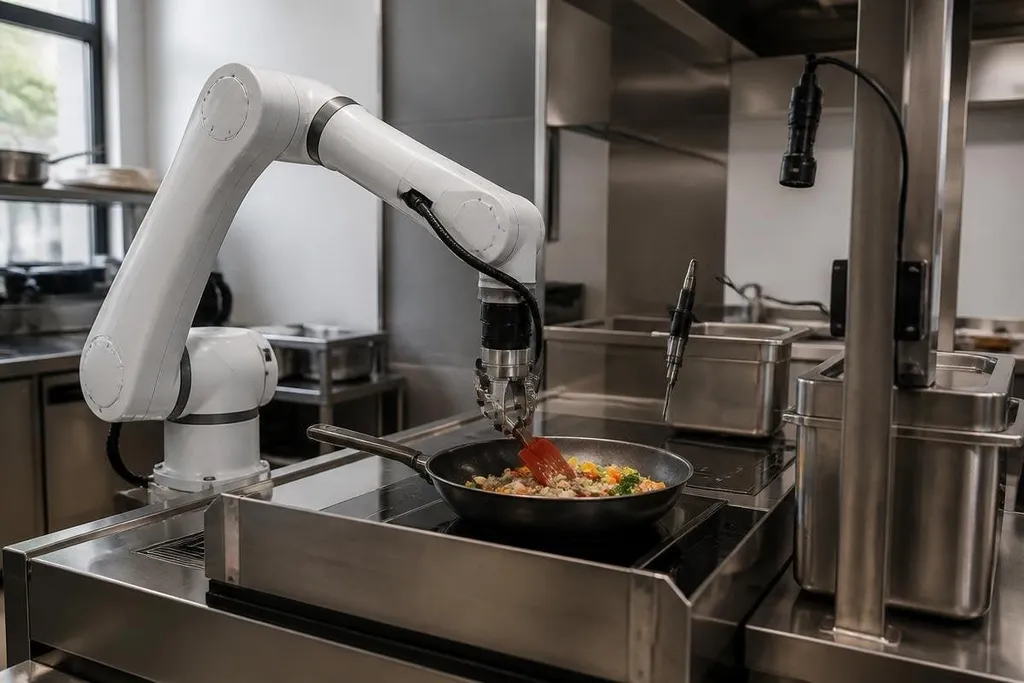
A cooking robot has to move food, control heat, and keep people away from moving parts. That makes a kitchen harder to automate than a task with fixed objects and a clear work area.
Quick read
- Cooking robots work best with set recipes, known ingredients, and fixed cookware.
- Heat, sharp tools, spills, and changing food sizes create safety problems.
- The real test is cleanup, supervision, and recipe range after the first week.
What a cooking robot actually does
A typical system may combine a robotic arm with a gripper, camera, temperature probe, and cooking surface. The arm moves a pan or utensil, the camera checks object position, and the probe reads heat inside the food.
That setup works from a sequence of instructions. A recipe might tell the arm to pick up a bowl, pour its contents into a pan, stir for a set time, and move the pan away from the heat. Each step depends on the previous one finishing in the expected position.
Food rarely stays that predictable. A tomato can roll, a sauce can thicken, and a piece of meat can change shape as it cooks. The robot then needs fresh sensor data and a safe way to pause when the scene no longer matches the recipe.
Where the benefits are real
The strongest use case is repeated preparation. A robot can handle set portions, repeat the same stirring path, or move ingredients through a fixed workstation while a person handles tasks that change from order to order.
That may help a commercial kitchen control portion size and timing.
It can also reduce repeated hand motions for staff, though the robot still needs a person to load ingredients, check the result, and deal with steps outside its programmed range.
Home kitchens present a different trade. A robot that cooks one narrow set of meals may save hands-on work, but it also needs counter space, power, cleaning, and a clear path around the pan. The owner pays for the whole setup, not only the arm.
Steam, spills, and a hand reaching across the pan can expose limits that a clean launch demo leaves out. A dated report on Robot24 can name the robot, task, test setting, and safety result before you judge what belongs in a home kitchen.
The risks sit around the pan
Heat is the first concern. Near a hot pan, the robot works around hot oil, steam, metal cookware, and open surfaces that can burn skin or damage sensors. A safe system needs limits on speed, force, temperature, and movement near a person.
Sharp tools create a second problem. A robot that holds a knife or moves a blade needs a fixed path, a guarded work area, and a clear stop method. A person reaching across the counter can change the risk in less than a second.
Food hygiene adds another layer. Grippers, utensils, and work surfaces need cleaning between tasks. Food residue can also affect a camera, jam a joint, or change the grip on a wet object.
Cleanup may decide the purchase. Sauce on a gripper or flour on a camera can stop a recipe, and the person still has to wash parts the robot cannot clean itself. I'd skip any system that hides those jobs behind a polished cooking demo.
What remains unproven
A demo can show a robot completing one recipe under controlled conditions. It doesn't prove that the same system can handle a crowded counter, a missing ingredient, a different pan, or a recipe change made during cooking.
Buyers should ask for details about the arm's payload, reach, wash-safe parts, temperature limits, stop controls, and software updates. They should also ask which steps need a person and how the maker handles a failed task.
A useful trial starts with a small menu. Run the same meals across several days, record pauses and cleanup time, and check how often a person must correct the robot. Those results matter more than the number of recipes shown in a launch video.
A practical buying checklist
Use these checks before you compare cooking robots:
- Set the menu: Choose meals you make often, then check each recipe step the robot can perform.
- Measure the workspace: Record counter depth, pan position, outlet access, and the arm's full reach.
- Check heat limits: Ask for the highest supported surface and food temperatures in writing.
- Plan cleaning: List every part that touches food and find out how it comes off for washing.
- Test failure recovery: Confirm how the system pauses after a spill, blocked gripper, lost object, or missing ingredient.
- Price the full setup: Include cookware, sensors, service, software fees, and replacement parts.
The right cooking robot will handle a narrow set of repeated tasks with clear supervision. Until makers show reliable recovery, easy cleaning, and safe work near heat, treat a broad home-cooking promise as a plan rather than a finished product.